

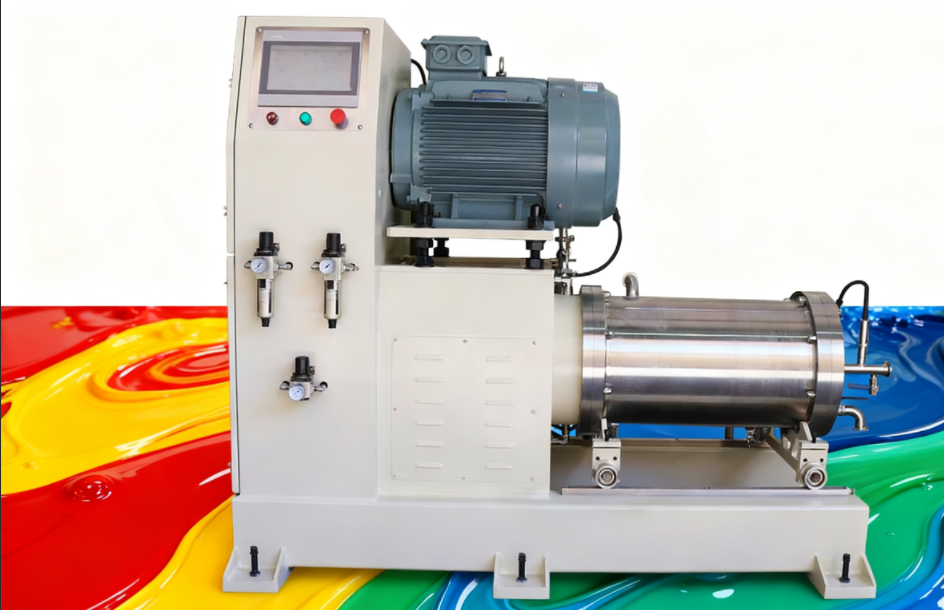
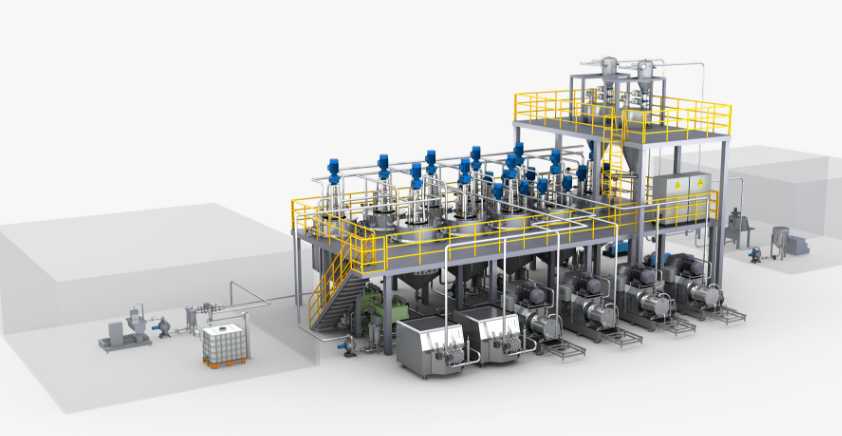
Bead mills are essential equipment in the production of modern pesticides, particularly environmentally friendly and highly effective formulations. Their primary function can be summarized as ultrafine grinding and uniform dispersion of the pesticide technical and adjuvants to produce formulations such as suspension concentrates and water-dispersible granules, which are highly stable and effective.
Pesticide technicals (especially water-insoluble solid technicals) need to be mixed with various additives (such as dispersants, wetting agents, thickeners, etc.) and then efficiently ground in a Bead mill.
Bead mills are primarily used in the production of the following dosage forms:
Suspension concentrates (SC): This is the primary application area for Bead mills. They process water-insoluble solid technical drugs into liquid dosage forms with high suspension ratios.
Water dispersible granules (WG): The technical drug and excipients are first ground in a Bead mill to form a high-content suspension concentrate, which is then spray-dried and granulated to produce the final WG. The quality of the initial grinding process directly determines the dispersibility and suspension ratio of the WG.
Suspoemulsions (SE): These complex systems contain both solid and liquid technical drugs. Bead mills are responsible for thoroughly grinding and dispersing the solid portion.
Seed coatings (FS): These require extremely high fineness and stability to ensure uniform coating.
Grinding pesticide particles to an extremely fine degree directly determines the quality and performance of the final product, which is reflected in:
Improved efficacy and bioavailability: Finer particles increase their specific surface area (the total surface area per unit mass). This means that after spraying, the pesticide solution can more thoroughly contact and adhere to its target (such as pests, pathogens, and weed leaves). Finer particles are also more easily absorbed by the target, significantly improving the drug’s bioavailability and control effectiveness, and in some cases even reducing the amount of technical pesticide used.
Improving the physical stability of formulations: This is one of the most critical functions of a Bead mill. In formulations like suspension concentrates (SCs) and emulsions in water (EWs), if the particles are too large, they will quickly settle and clump (sedimentation and water separation) due to gravity, resulting in product failure. Ultrafine grinding in a Bead mill reduces particles to micrometers, significantly enhancing Brownian motion (random molecular motion). This effectively offsets the effects of gravity, maintaining a stable, long-term suspension in the liquid. This significantly extends the product’s shelf life and prevents nozzle clogging during use.
Improved suspension and dispersibility: While grinding, the Bead mill also vigorously coats the surface of each tiny particle with dispersants and other additives, preventing particles from reaggregating. This allows the pesticide formulation to quickly and spontaneously disperse into a uniform suspension when diluted with water, eliminating precipitation and ensuring consistent concentration in every drop of liquid, thereby ensuring uniform application.
Meeting environmentally friendly and high-standard formulation requirements: With increasing environmental protection requirements in agriculture, traditional, highly polluting formulations (such as emulsifiable concentrates and wettable powders) are being replaced by safer, more environmentally friendly suspension concentrates (SCs). The production of SCs is absolutely essential, as bead mills are central to producing high-quality SCs.
In short, bead mills play the role of “nano-processing masters” in pesticide production. By providing powerful mechanical energy, they “grind” pesticide particles to the micron or nanometer scale and achieve perfect coating of adjuvants, ultimately addressing the three core issues of efficacy, stability, and environmental friendliness. Without Bead mills, the production of the highly efficient, safe, and environmentally friendly pesticide formulations that dominate the market today would be impossible. They are key equipment for modern pesticide formulation process and product upgrades.

 EN
EN  ES
ES  PT
PT  FR
FR  JA
JA  KO
KO