

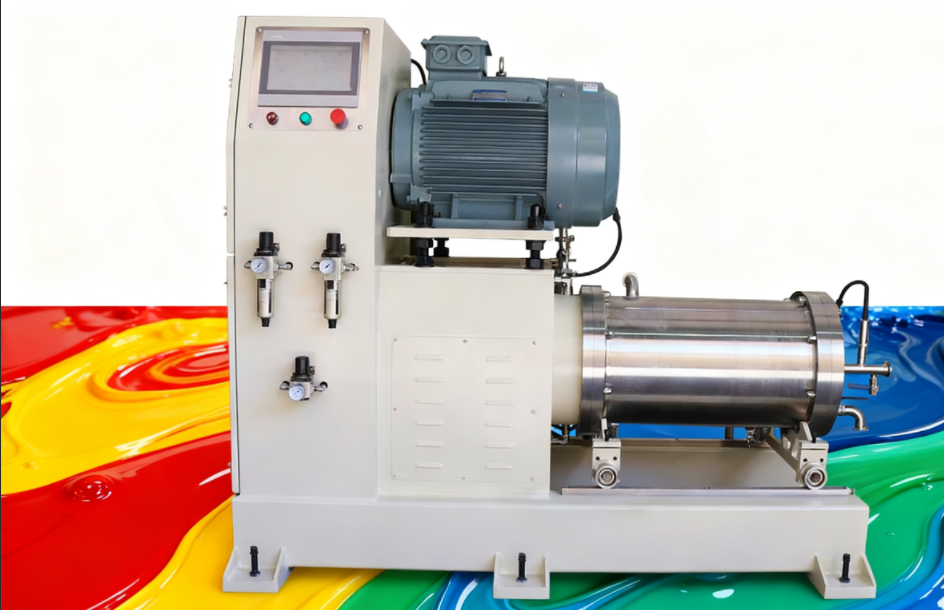
A bead mill is a crucial piece of dispersing and grinding equipment in the coating production process. Its core mission is to efficiently grind and disperse pigment aggregates and other solid particles in the coating to micron or even nanometer fineness, resulting in a stable, uniform coating product with excellent performance.
You can think of it as a highly efficient “ultrafine particle processing center.”
I. Why do we need a bead mill? — Core Problems It Solve
Coatings are composed of resin (film former), pigment (providing color and hiding power), filler (reducing cost or imparting specific functionality), additives, and solvents. During the initial mixing stage, pigments and fillers exist as large, invisible “agglomerates.” If these agglomerates are not broken down, the results can be:
Offset and dull color: Agglomerates prevent the pigment’s natural color from fully developing.
Poor hiding power: Large particles allow light to penetrate easily, failing to cover the substrate.
Rough surface and low gloss: Large particles prevent the coating film from forming a smooth, even surface.
Poor stability and easy sedimentation: Large particles are more likely to settle to the bottom and clump together, making them difficult to remix.
Degraded performance: This affects the durability, corrosion resistance, and adhesion of the coating film.
bead mills exist to thoroughly address these issues.
II. Specific Uses of bead mills in coating Production
Achieving Fine Pigment Dispersion
Using mechanical forces (collision and shearing of the grinding media) to break up pigment agglomerates and convert them into independent primary particles.
These tiny pigment particles are fully and evenly encapsulated (wetted) by the resin (coating), forming a stable suspension.
Ensuring Product Fineness: A Key Parameter
Fineness is a crucial metric in coating quality standards, typically measured in microns (μm). Different coatings have strict fineness requirements (for example, high-gloss automotive topcoat requires a fineness of less than 10 μm).
bead mills are the core equipment for controlling and achieving this metric.
Improves the final performance of the coating.
Optical properties: Enhances color vividness (color development), tinting efficiency, and film gloss.
Rheological properties: Improves the flow and leveling properties of the coating, resulting in a smoother film appearance.
Stability: Significantly delays settling and agglomeration, extending the product’s shelf life.
Applicability: Prevents spray gun nozzle clogging during spraying, improving application efficiency.
Film properties: Produces a denser, more uniform coating film, enhancing its hardness, abrasion resistance, corrosion resistance, and adhesion.
III. The bead mill’s Position in the coating Production Process
It serves as a critical link between the preceding and following stages:
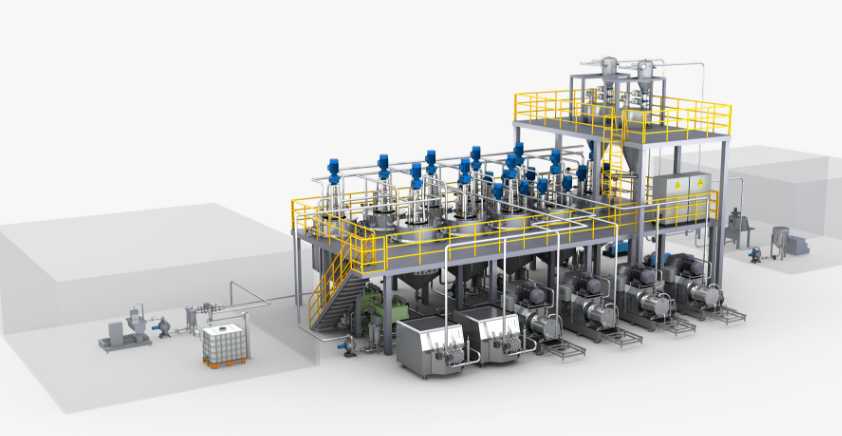
Feeding → High-speed disperser (pre-mixing, initial breakup of large lumps) → bead mill (fine grinding to the specified fineness) → coating mixing tank (addition of additives, color adjustment, and viscosity adjustment) → Filtration → Packaging
Summary
In the coatings industry, a bead mill is far more than just a grinding machine. It is a key executor in transforming coating formulations from “blueprint” to “high-performance product.” Without the fine processing of a bead mill, it would be impossible to achieve the high decorative properties, high protection, and excellent application experience required by modern coatings. It is an indispensable core equipment for coatings manufacturers, especially those producing mid- to high-end products.


 EN
EN  ES
ES  PT
PT  FR
FR  JA
JA  KO
KO