

Paint is composed of resin (film former), pigment (provides color and hiding power), filler (adds volume or specific properties), additives, and solvent. During the initial mixing stage, pigments and fillers exist as large aggregates. If used directly, the paint may suffer from the following problems: Dark color and inaccurate hue. Rough surface and low gloss.Poor hiding power.Poor stability and easy sedimentationThe function of a bead mill is to mechanically break up these aggregates, allowing individual pigment particles to be fully wetted by the resin (paint) and evenly dispersed, forming a stable, uniform suspension.
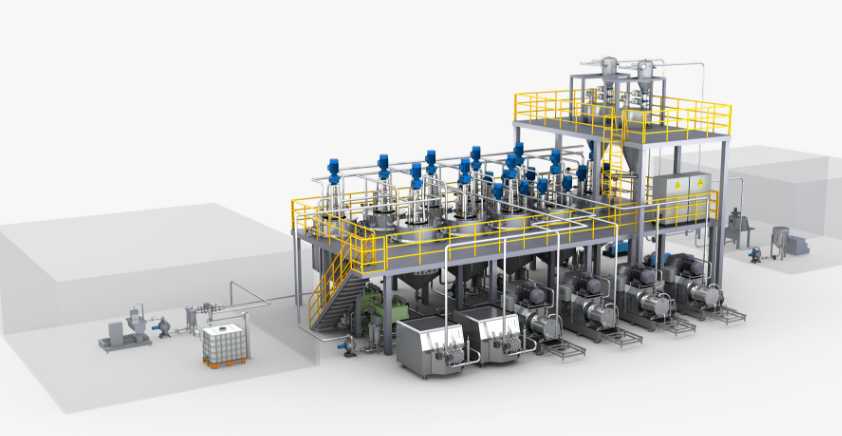
The role of bead mill in paint production process: Bead mills are typically located after the “pre-dispersion” (high-speed mixing) step and before the “paint mixing” step (color matching and viscosity adjustment), forming the core of the entire dispersion process.
Process Flow Diagram:Injection → High-Speed Disperser (Pre-mixing, Initial Dispersion) → bead mill (Fine Grinding to Specified Fineness) → Paint Mixing Pot (Adding Remaining Ingredients, Adjusting Final Properties) → Filtration → PackagingIII. Specific Performance and Benefits of the bead mill
Improved Color Performance
Color Rendering and Tinting Strength: When pigment particles are fully ground and dispersed, their specific surface area increases, allowing for more efficient reflection and absorption of light, significantly enhancing color vividness (color rendering) and tinting efficiency (tinting strength).
Color Consistency: Ensuring consistent fineness across batches ensures color stability and reproducibility, preventing color variations.
Improving Paint Film Appearance and Performance.
High Gloss: Finer particles create a smoother and flatter paint film surface, resulting in more concentrated light reflection and a higher gloss (especially critical for high-gloss paints).
Smoothness and Handfeel: Fine particles create a highly refined, smooth paint film surface.Enhanced Durability: A fully dispersed system is more stable, reducing paint film defects (such as pinholes and orange peel) caused by large particles, and improving adhesion, abrasion resistance, and weather resistance.
Ensuring Product Stability
Preventing Settling and Agglomeration: According to Stokes’ Law, finer particles settle more slowly in liquids. Fine grinding effectively prevents pigments and fillers from settling and agglomerating during storage, extending the shelf life of the product. Even slight settling is easy to re-mix.
Optimizing Application Performance
Paints with the correct fineness are less likely to clog the spray gun during spraying.
Excellent leveling properties make it easier to form a smooth paint film.
What Types of Paints are Suitable?
Bead mills are widely used in liquid paints requiring high fineness, particularly:
Industrial paints, such as automotive paints, appliance paints, and coil paints, require extremely high appearance and performance.
Wood paints, which require high transparency and fullness.
High-performance anti-corrosion paints, such as epoxy zinc-rich primers and epoxy midcoats, require a thorough dispersion of zinc powder and other anti-rust pigments.
Decorative paints, such as metallic glitter and pearlescent paints, can be used with both water-based and solvent-based paints.
Summary
In the paint industry, bead mills are more than just “grinding” equipment; they are also the core of the “finishing” process that determines the quality, performance, and stability of the final product. They physically maximize the potential of a formulation and are essential for producing high-quality, high-value-added paints. Without the precise processing capabilities of bead mills, achieving the high gloss, decorative properties, and superior protective properties required by modern paints would be impossible.


 EN
EN  ES
ES  PT
PT  FR
FR  JA
JA  KO
KO