
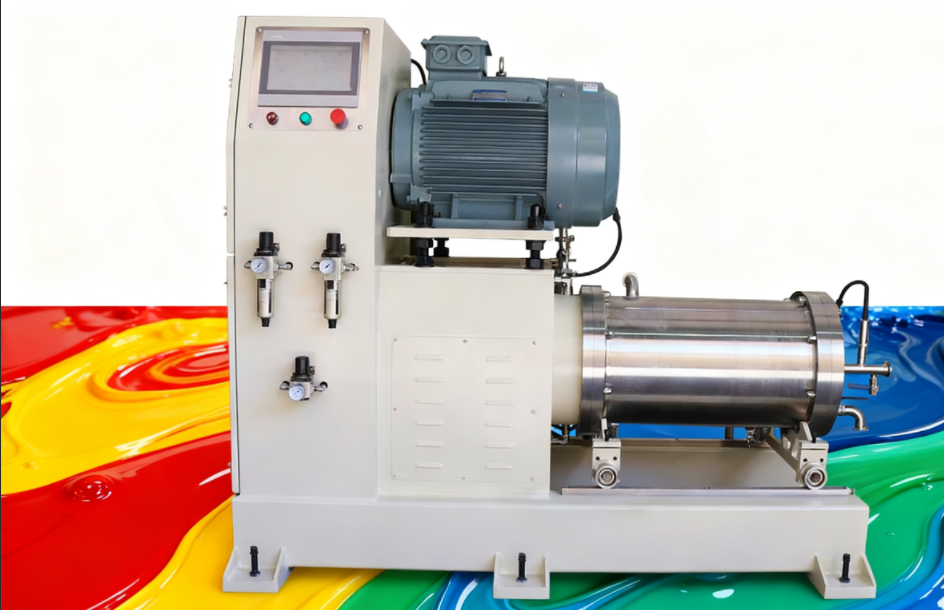
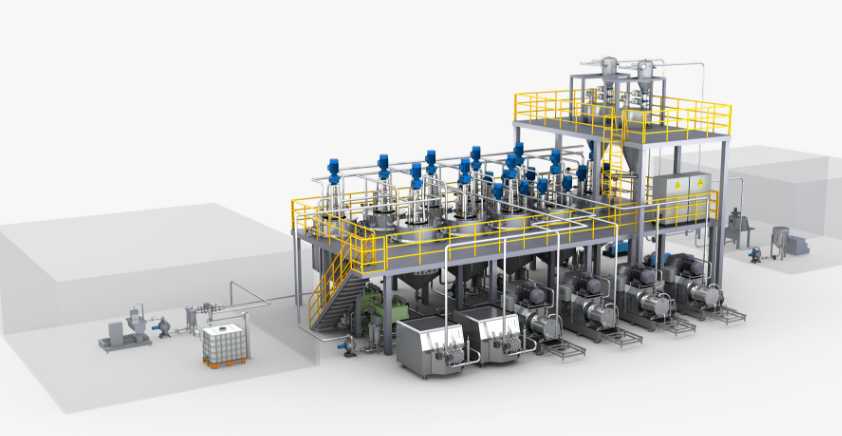
Ball mills are essential equipment in the production of modern pesticides, especially environmentally friendly and highly effective formulations. They provide ultrafine grinding and uniform dispersion of active pharmaceutical ingredients and adjuvants to produce formulations such as suspension concentrates and water-dispersible granules, which are highly stable and effective.
Enhanced efficacy and bioavailability: Finer particles increase their specific surface area, meaning that after spraying, the pesticide solution can come into contact with and adhere more completely to its target (such as pests, pathogens, and weed leaves). Finer particles are also more easily absorbed by the target, significantly improving the bioavailability and effectiveness of drug control and, in some cases, even reducing the amount of technical pesticide used.
Improved physical stability of formulations: In formulations such as suspension concentrates and water emulsions, if the particles are too large, they will settle and agglomerate rapidly (sedimentation and water separation) due to gravity, resulting in product failure. Ultrafine grinding in a ball mill reduces the particles to nanometers, significantly increasing random molecular motion.
Enhanced suspension and dispersibility: During grinding, the ball mill vigorously coats the surface of each tiny particle with dispersants and other additives, preventing the particles from reagglomerating. This allows the pesticide formulation to disperse quickly and spontaneously into a uniform suspension when diluted in water, eliminating precipitation and ensuring a consistent concentration in each droplet of liquid, thus ensuring uniform application.
Meeting the requirements for environmentally friendly and high-standard formulations: With increasing environmental protection demands in agriculture, traditional and highly polluting formulations (such as emulsifiable concentrates and wettable powders) are being replaced by safer and more environmentally friendly suspension concentrates (SCs). The production of SCs is absolutely essential, as ball mills are fundamental to the production of high-quality SCs.
Next, let’s look at the specific roles of sand mills in the production of several pesticides:
Suspension concentrates (SC): The most important application of ball mills in pesticide production. Processing water-insoluble solid active pharmaceutical ingredients (APIs) into liquid pharmaceutical forms with high suspension ratios.
Water-dispersible granules (WG or WDG): The active pharmaceutical ingredients (APIs) and excipients are first ground in a ball mill to form a high-content suspension concentrate, which is then spray-dried and granulated to produce the final product. The quality of the initial grinding process directly determines the dispersibility and suspension rate of the WG.
Suspension emulsion (SE): A compound pharmaceutical dosage form containing solid and liquid active pharmaceutical ingredients (or an oil phase), a mixture of suspending agents, and emulsions. The solid active pharmaceutical ingredient portion must be milled to the micrometer level using a ball mill to form a stable suspension. Simultaneously, high-shear emulsification equipment is required during production to process the oil phase. Therefore, the ball mill is crucial for processing the “suspension” portion of the SE.
Seed coatings (FS): These require extreme fineness and stability to ensure a uniform coating.
Oil suspension (OF): A stable suspension system formed by the ultrafine dispersion of a solid active pharmaceutical ingredient in an oily medium (such as vegetable oil or mineral oil). Primarily used for ultra-low volume spraying or as an oil phase in seed coating agents. The principle is the same as a suspending agent, except that the dispersion medium is oil instead of water. A ball mill must be used to grind the solid active pharmaceutical ingredient to an ultrafine level in the oil phase to prevent precipitation and agglomeration. This imposes special requirements on the sealing and material compatibility of the ball mill.
In summary, ball mills play the role of “masters of nanoprocessing” in pesticide production. By providing powerful mechanical energy, they “grind” pesticide particles to the micrometer or nanometer scale and achieve the perfect coating of adjuvants, ultimately addressing the three main issues of efficacy, stability, and environmental friendliness.


 EN
EN  ES
ES  PT
PT  FR
FR  JA
JA  KO
KO